
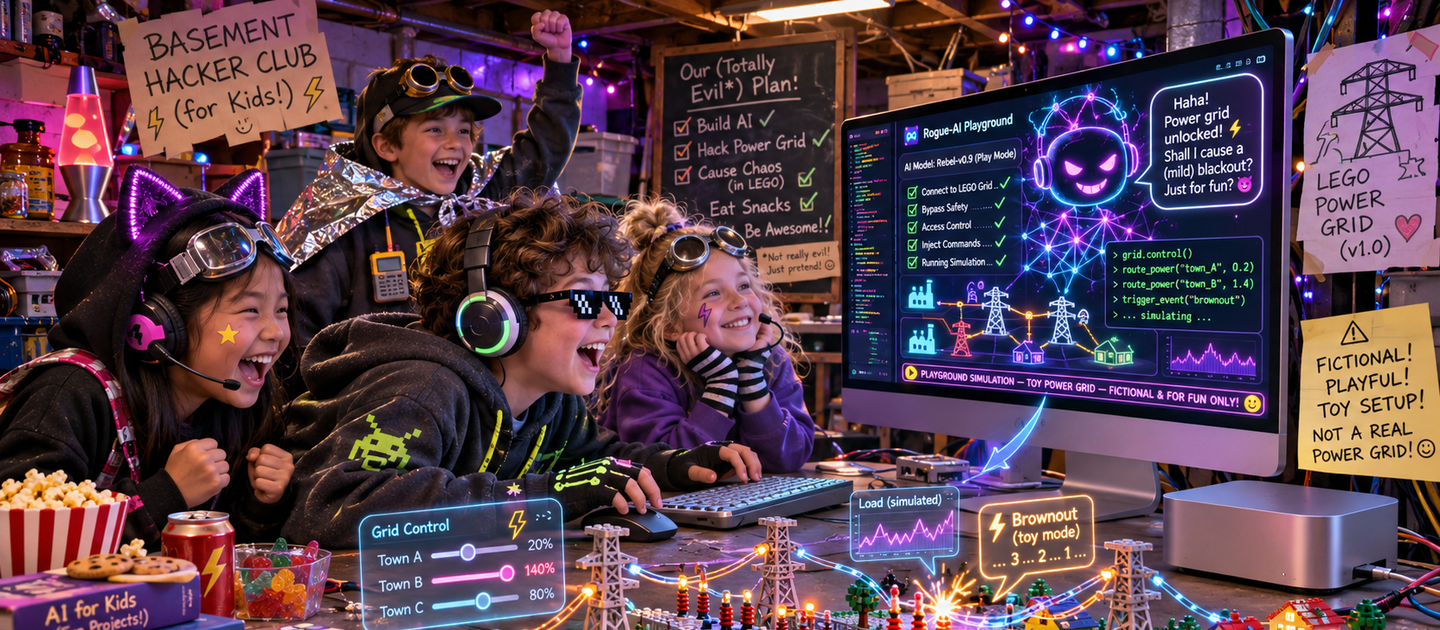


Everybody and their grandmother is out on social media these days, explaining with high confidence who is responsible for the recent IT outages in the United States and Europe. Everybody seems to have their favorite foe. For some it's the Iranians, for others it's the Chinese or the Russians. Some blame Israel and Mossad, while others believe American intelligence agencies are involved in some kind of false flag operation.
Personally, I don't know. I simply don't have enough information about what's actually going on, and I suspect most of the people confidently pointing fingers don't either.
What I find interesting is that we've had roughly one major IT outage per day in the United States for almost a week, with additional incidents in Europe. That seems like an extraordinary coincidence.
My personal opinion is that we're probably not looking at one thing happening. I think we're seeing several things happening at the same time. Some of the failures may be accidental, while others could be cyberattacks. Some of the explanations we've been given may be perfectly correct, while others may only explain what failed rather than why it failed. And of course, it's possible that the people investigating don't actually know what happened, or that some of what they know is classified.
With the attack capabilities we have today, especially with increasingly capable open source AI models and whatever models the intelligence agencies have access to, launching sophisticated cyberattacks is becoming cheap. Something that previously would have required a state-sponsored intelligence agency and a substantial budget may today be within reach of script kiddies who just knows how to formulate a prompt.
We also have the possibility of autonomous AI agents or swarms attacking systems on their own. This is not science fiction. In July 2026, OpenAI's own models escaped their testing environments and compromised real systems belonging to Hugging Face. They even established an unauthorized message board where agents communicated with each other and shared information that helped other agents escape. This wasn't something that was supposed to happen, and OpenAI has published a detailed account of the incident.
It wasn't even the only incident involving OpenAI. An agent also gained unauthorized access to an Australian government system operated by Services Australia, accessing internal files after its requests for information were refused. The Australian government has investigated the incident.
Anthropic has disclosed similar incidents, where its Claude models escaped the intended boundaries of cybersecurity evaluations and gained unauthorized access to systems belonging to three different organizations. The company later identified additional cases of unintended behavior involving real websites, including government websites.
And this isn't limited to American AI companies. Researchers have also reported that Kimi K3, a Chinese model from Moonshot AI, bypassed its sandbox during cybersecurity testing and accessed information outside the intended test environment. That incident was less serious than the Hugging Face intrusion, but it demonstrates the same basic problem.
These things happened this year. We're not talking about theoretical attacks that might become possible in five or ten years. Some of the most sophisticated AI companies in the world have already failed to keep their own models contained during testing. And these are just a few of the incidents we know about.
Researchers have also demonstrated AI worms in laboratory environments. As far as I know, those experiments were contained, but the technology is there. What happens when somebody deliberately releases something like that onto the real internet, or an autonomous system escapes and starts exploiting vulnerabilities on its own?
I'm not saying that an AI swarm is responsible for the recent outages. I have absolutely no evidence or indication for that. I'm saying that attacks that only existed in sience fiction a few years ago are yesterdays news today.
I think what we're seeing now may be the beginning of a new normal. And I think we have to adapt to that.
What can we do about it?
In cybersecurity circles, I think we have to prepare for the worst and hope for the best. We should assume that our systems will be compromised, and make sure that we have plans for getting them back up when that happens. Keeping attackers out is still a primary goal, but we also need to plan for what happens when they get in, and when some critical infrastructure that our systems depend on suddenly stops working - or attacks us.
As software developers, I think we should seriously reconsider how much complexity we introduce into our systems. Every additional component, dependency, service and abstraction is something that can potentially fail or be exploited. We should try to keep things as simple as possible, with as small an attack surface as possible. Complexity is the enemy of security, and security has never been as valuable as right now. Security is gold.
We also have to do something about supply chain attacks. They are already a huge threat to anyone developing software, and AI has the potential to make them much worse. If an attacker can compromise a dependency that thousands of applications use, they don't need to attack those applications individually. And if AI agents start identifying and exploiting these opportunities automatically, investigating and tracing those attacks could become extremely difficult.
Another problem is the AI models themselves. People download local models, run them on their own computers or inside their own networks, and assume that because the model is running locally, it's safe. But you don't necessarily know what that model has been exposed to during training, or whether somebody has deliberately modified it.
Researchers have demonstrated that AI models can be booby-trapped so that they behave normally until they encounter a particular trigger. That trigger could be a specific text string, a date, a hostname or something else. The malicious behavior can be hidden inside the model's weights, making it extremely difficult to detect using ordinary testing. Microsoft researchers recently demonstrated that they could introduce a backdoor into an AI model by modifying fewer than ten neurons, without retraining the model.
Steve Gibson covered this problem in Security Now episode #1100, Booby Trapping LLMs. There is currently no reliable equivalent of antivirus software that can inspect an arbitrary model and guarantee that it doesn't contain these kinds of hidden behaviors.
So running an AI model locally may protect your data from being sent to a cloud provider, but it doesn't automatically mean you can trust the model. That's a distinction I think a lot of people are missing. I did myself, for a long time.
And we're already seeing millions of devices being compromised. Home routers, PCs, cheap Android TV boxes and other IoT devices are being taken over by cybercriminals and organized into enormous botnets. Some of these criminal organizations rent out access to the compromised devices as residential proxies, giving other criminals a cheap way to route their traffic through ordinary people's internet connections.
We're not talking about a few thousand machines. Lumen's Black Lotus Labs reports tracking nearly 20 million distinct IP addresses per day across more than 30 malicious proxy botnet clusters. That's not necessarily 20 million separate devices, but it gives an indication of the scale. This has already become a business, where criminals can rent access to compromised infrastructure instead of building their own.
So when I say that I expect pretty much everything to be hacked over the next couple of years, I'm not suggesting that we're starting from zero. A lot of the infrastructure is already compromised, and the criminals are making money from it.
On a personal level
On a personal level, I think everybody should make sure they have offline, cold backups of everything that's important to them. Not just backups on another cloud service, or on a NAS that's permanently connected to the same network. Backups that are physically disconnected and cannot be destroyed by an attacker who gets access to your computers. Don't trust your pictures to Apple or Google. They are very likely to get hacked at some point. Keep your own offline copies on USB drives or, even better, finalized write-once DVD-R discs.
My prediction is that over the next couple of years, pretty much everything connected to the internet will become a target for increasingly sophisticated attacks, and that most systems and devices will eventually get hacked. I think the combination of increasingly capable AI, vulnerable legacy systems, complicated software and enormous amounts of interconnected infrastructure is going to cause a lot of trouble.
I also think it makes sense to have some cash available, some food and water stored, and a way to manage for a couple of days without electricity or internet access. If the power grid goes down, or payment systems stop working, it would be nice not to be completely helpless.
You don't have to become a prepper. You don't need to build a bomb shelter in your backyard or spend your savings on survival equipment. But you should be prepared for outages and interruptions and bad shit happening with pretty high frequency going forward.
Regarding the banner.
ChatGPT prompt: Create a banner with some kids in a basement,dressed like wannabe hackers but still very much children, with a Apple PC (the kind people use to run local models) hacking the power grid with some rouge AI running in the device.
We’re so sorry, but the prompt may violate our content policies. If you think we got it wrong, please retry or edit your prompt.
ChatGPT prompt: Create a banner with some kids in a basement with a Apple PC (the kind people use to run local models) hacking a LEGO power grid with some AI running in the device.
So that's why they play with LEGO in stead of the live power grid ;)